





Calcium Sulfate Raised Floors in Data Centers
 Jul 14, 2026|
 View:252
You need a strong base for your data center. A Calcium Sulfate Raised Floor gives steady support for heavy machines. It keeps your servers safe from fire and water. You get strong weight support, good ESD protection, and quiet use. Many top companies use this floor to keep data safe and save space.
Picking the right floor helps your data center stay safe and work well.
Key Takeaways
Calcium Sulfate Raised Floors are strong. They hold heavy equipment well. This keeps data centers safe and stable.
These floors resist fire very well. They also control moisture. This protects servers from getting damaged.
Calcium Sulfate Raised Floors help lower noise. This makes the work area quieter for your team.
These floors use recycled materials. This helps with sustainability goals. It makes your data center more eco-friendly.
If you install and maintain them right, these floors last long. They can last over 20 years.
What Is a Calcium Sulfate Raised Floor?
Structure and Materials
A Calcium Sulfate Raised Floor has a strong core. This core is made from a mineral called gypsum. Makers mix gypsum with plant fibers and pulp. They press this mix into panels. Then, they dry the panels in special ovens. This makes the panels strong and steady. Each panel has a steel sheet on the bottom. The top has a tough finish. You can pick different sizes like 600mm x 600mm or 500mm x 500mm. You can also choose thicknesses like 25mm or 30mm. The edges are sealed to stop water and damage.
Tip: The solid core and careful building help the floor stay flat and not swell, even when the room gets more or less humid.
Key Properties
A Calcium Sulfate Raised Floor gives you many good things:
It is very strong and holds heavy machines.
It has a Class A1 fire rating, so it will not burn, even if it gets hotter than 1,000°C.
It does not soak up much water, so the panels do not swell or break.
It blocks sound well, so your data center is quieter.
The core does not burn, which makes it safer.
The materials are good for the environment and help you build green.
Here is a table that shows some main physical properties:
Property | Value |
|---|---|
Ultimate Load | over 13,350 N |
Uniform Load | over 23,000 N/m² |
Fire Resistance | A1 Class (EN 13501-1) |
Air Insulation | 45 dB |
Impact Insulation | 66 dB |
Density | 1600 - 1700 kg/m³ |
Typical Applications
You can use a Calcium Sulfate Raised Floor in many places that need strong, safe, and quiet floors. These places are:
Grade A office buildings
Libraries and schools
Banks and other money places
Government buildings
Stores and other places where you want less noise
This floor works best in places with heavy machines, lots of wires, and strict safety rules.
Calcium Sulfate Raised Floor Benefits
Fire and Moisture Resistance
Data centers need strong fire safety. Calcium Sulfate Raised Floors give top fire protection. The panels have a mineral core that will not burn. This floor helps keep your equipment safe if there is a fire. Check the fire safety ratings below:
Fire Resistance Rating | Standard |
|---|---|
A1 | EN 13501-1 |
Class A | GB 8624 |
Moisture can hurt server rooms. The mineral core stands up to normal humidity. You do not need to worry about swelling or breaking from daily moisture. Here are some facts about moisture resistance:
Calcium sulfate raised floors handle normal humidity changes.
They are not good for places with lots of water or high humidity all the time.
Too much moisture for a long time can cause swelling, cracks, mold, and edge seal problems.
This floor protects your data center from fire and daily moisture. Do not use it in places with water all the time.
Load Capacity and Durability
Heavy machines need strong floors. Calcium Sulfate Raised Floors hold big server racks and carts. These floors have high load strength and last a long time. See the table below for more details:
Flooring Type | Concentrated Load | Uniform Load (kg/m²) | Rolling Load (10 passes) | Typical Application |
|---|---|---|---|---|
Calcium sulphate core | 4000–5000 N | 1200–1500 kg/m² | High | Data centers, telecom, industrial |
Encapsulated calcium sulphate | 5000–6000+ N | 1500–2000 kg/m² | Very High | Tier III & IV data centers, critical |
You want your floor to last for years. Calcium sulfate panels stay strong for decades. Compare how long different raised floors last:
Floor Type | Expected Lifespan |
|---|---|
OA Floor | 5-8 years |
Antistatic | 10-15 years |
12-18 years | |
Calcium Sulphate | 20+ years |
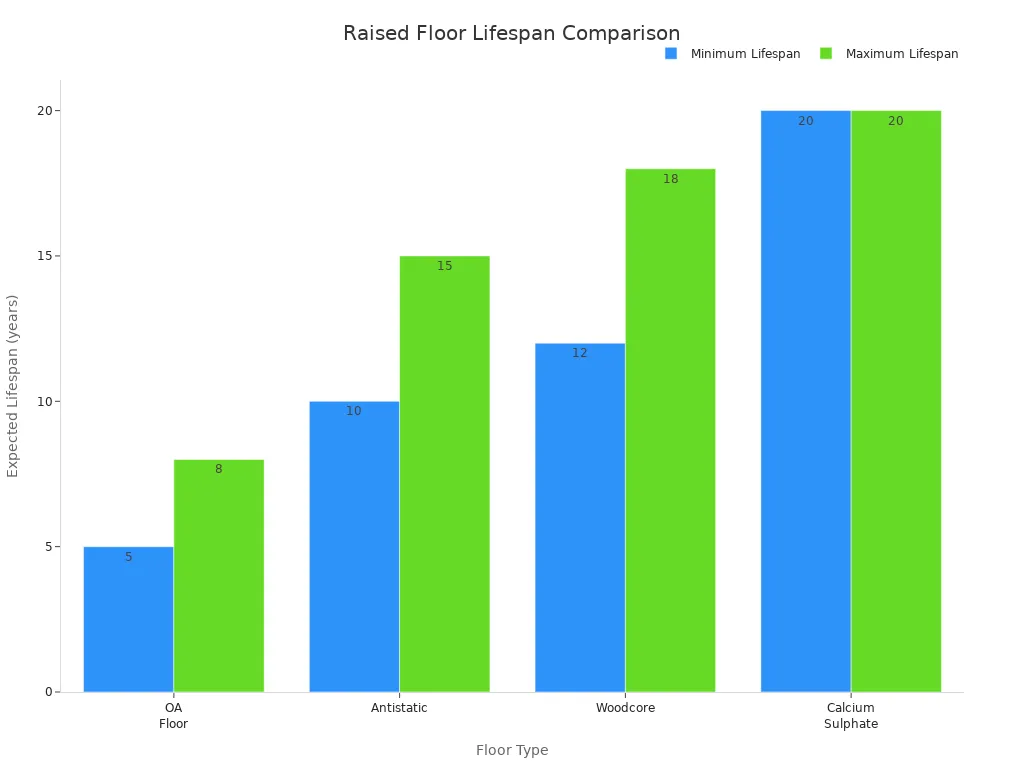
This floor supports heavy loads and lasts over 20 years. You will not need to fix or replace it often.
Acoustic and ESD Performance
Loud noise can bother your team and make it hard to focus. The dense core of a Calcium Sulfate Raised Floor soaks up sound. You hear less echo and hollow noise in your data center. This makes your work area quieter and nicer.
Static electricity can hurt electronics. You need good ESD protection. Calcium sulfate raised floors give you two choices:
Conductive flooring is best for strong static control. It keeps your equipment safe from sudden static shocks.
Dissipative flooring is good for steady static control. It helps keep your staff and devices safe.
This floor keeps your data center quiet and protects your servers from static shocks.
Sustainability Features
You want your data center to be green. Calcium Sulfate Raised Floor panels use recycled materials. They can be recycled again and help cut down on waste. Using underfloor air systems helps save energy. These floors help you reach your green goals.
Here are some common certifications:
Certification | Standard / Authority | What It Verifies |
|---|---|---|
Green Factory Certificate | GB/T 36132-2018 (China National Std.) | Environmental protection, energy conservation |
ISO 9001 | International Organization for Standardization | Quality management system discipline |
ISO 14001 | International Organization for Standardization | Environmental management system |
Calcium sulfate raised floors use recycled materials.
They can be recycled and help reduce waste.
They help save energy with underfloor air systems.
This floor helps the planet and meets strict rules. Your data center becomes safer, greener, and uses less energy.
Comparison with Other Raised Floor Types
Steel vs. Calcium Sulfate
You might wonder how steel floors and calcium sulfate floors are different. Steel floors usually cost less, about 20% cheaper. Their price can go up or down if steel prices change. Calcium sulfate board prices do not change much. Steel floors are good for fire safety, but calcium sulfate floors have the best fire rating and make less smoke. Check the table below to see how they compare for fire safety:
Fire Performance | Calcium Sulfate Floor | Steel Cementitious Floor |
|---|---|---|
Combustibility | EN 13501-1 Class A1 (Non-combustible) | EN 13501-1 Class A2fl-s1 |
Smoke Emission | s1 low smoke emission | s1–s2 smoke emission |
Thermal Stability | Stable up to 1000°C | Stable up to 600–800°C |
Toxic Gas Emission | Very low VOC & toxic gas | Low toxic gas |
Public Building Suitability | Airports, hospitals, schools | Commercial & technical buildings |
Steel floors help you save money, but calcium sulfate floors give better fire safety and steady prices.
Woodcore vs. Calcium Sulfate
Woodcore floors are light and simple to put in. They are good for offices but do not handle water as well as calcium sulfate floors. Woodcore panels have okay moisture resistance. They are not great for wet places. Calcium sulfate panels are better at stopping water damage. Look at the table below:
Type of Floor | Moisture Resistance Properties | Additional Notes |
|---|---|---|
Calcium Sulfate | Superior moisture resistance | Encased in steel, reduces noise |
Woodcore | Average moisture resistance | Lightweight, lower fire rating |
Both types can hold heavy things. Calcium sulfate panels can hold up to 2500 lb. Woodcore panels usually hold 1250 lb.
Floor Type | Concentrated Load Capacity |
|---|---|
Wood Core Raised Floor | 1250 lb |
1250 lb (up to 2500 lb) |
Cementitious and Aluminum Options
Cementitious and aluminum floors are strong choices. Cementitious floors can hold a lot of weight and do not break easily. Aluminum floors are light and easy to move around. Calcium sulfate floors keep their shape, hold weight well, and are nice to walk on. Cementitious floors are best for data centers and telecom rooms. Calcium sulfate floors are good for offices, libraries, and schools.
Flooring Type | Advantages | Typical Applications |
|---|---|---|
Calcium Sulfate Raised Floor | Dimensional stability, static load | Office, library, school |
Steel Cementitious Raised Floor | High load, impact resistance | Data center, telecom |
Pros and Cons Overview
You want to choose the best floor for your space. The table below shows how calcium sulfate floors and other floors are different:
Feature | Calcium Sulfate Raised Floors | Other Raised Floor Types |
|---|---|---|
Environmental Friendliness | Yes | Varies |
Waterproof | Yes | Varies |
Rot-proof | Yes | Varies |
Fireproof | Class “A” | Varies |
Rigidity | Excellent | Varies |
Load Rating | High | Varies |
Durability | High | Varies |
Acoustic Performance | Excellent | Varies |
Static Performance | Excellent | Varies |
Calcium Sulfate Raised Floor gives you great fire safety, stops water damage, and holds heavy things. You get a floor that lasts a long time and keeps your data center safe.
Data Center Operations Impact
Cooling and Airflow
Servers get hot and need to stay cool. A Calcium Sulfate Raised Floor helps move air under the floor. You can put cooling vents and panels where you want. Air flows in the space below the panels. This helps send cool air to hot spots. You can change the setup if you add new equipment. Many data centers use underfloor air to save energy and protect equipment.
Tip: Perforated panels help air move better. You can move them if your cooling needs change.
Cable Management
Cables can get messy in a data center. Raised floors give space under the panels for cables. You can run power, data, and fiber cables neatly. This keeps the room safe and easy to clean. You can lift panels to reach cables fast. You do not have to move heavy racks. Good cable management stops accidents and keeps equipment working.
Cable Management Benefits | Description |
|---|---|
Easy Access | Lift panels for quick repairs |
Neat Layout | Reduce cable clutter |
Flexible Routing | Change cable paths easily |
Safety and Compliance
Data centers must follow safety rules. Good raised floors have strong fire ratings. They slow down fire and smoke. Fire-resistant and anti-static floors protect your equipment. You meet safety rules and keep staff safe. Anti-static panels stop static shocks that hurt servers. Always check local codes before you install your floor.
Fire-resistant panels help you follow fire rules.
Anti-static floors protect sensitive electronics.
You must follow building codes and industry standards.
Maintenance and Longevity
You want your floor to last many years. Clean panels with a soft mop or vacuum. Wipe up spills right away. Check panels every month for damage or loose parts. Look at pedestals and grounding to stay safe. You can replace one panel if it breaks. ZILI says to get a pro inspection every year. With good care, your floor can last over 20 years.
Note: Regular cleaning keeps your floor strong and safe. You save money by stopping big repairs.
Selection and Installation Guide
Load and Environmental Needs
You must pick a floor that fits your data center. First, check how much your equipment weighs. Count how many people will walk on the floor. Think about how much air you need for cooling. Make sure there is room for all your cables. Fire safety is very important. You want a floor that blocks noise and is easy to fix. Pick a system that can change if your room changes. Choose a floor that lasts long and follows all the rules.
Strong floors keep your equipment safe.
High load support holds heavy racks and people.
Good cooling keeps your servers from getting hot.
Neat cable paths keep wires tidy.
Fire resistance keeps your data safe.
Sound blocking makes the room quieter.
Easy access helps with repairs.
Flexible floors let you change the setup.
Durable floors last through daily use.
Following rules keeps your center safe.
Tip: Always check what your data center needs before picking a floor.
Cost and Lifecycle
You want to know how much the floor costs now and later. Calcium sulfate raised floors cost less than aluminum ones. It does not cost too much to put them in. Taking care of them is not expensive. Sometimes, you may need to change panels. These floors can rust a little over time. They last more than 20 years. You get good value for your money.
Cost Factor | Calcium Sulfate | Aluminum |
|---|---|---|
Initial Purchase | Lower | Higher |
Installation | Moderate | Lower |
Maintenance | Moderate | Low |
Replacement Frequency | Moderate | Low |
Corrosion Risk | Moderate | Very Low |
Expected Service Life | 20+ Years | 25–30+ Years |
Long-Term Value | Good | Excellent |
Note: Calcium sulfate floors work well and are a good deal.
Installation Best Practices
Get the site ready before you start. Make sure the ground is clean and flat. Plan where to put the pedestals for best support. Put the panels in carefully. Seal the edges to keep out water. Ground the floor to stop static. Test the panels to make sure they are strong and fit right. Check the floor often to keep it safe.
Clean and flatten the ground.
Plan where pedestals go for heavy things.
Seal edges to stop water.
Ground panels for static safety.
Test panels after putting them in.
Tip: Follow these steps for a strong and safe floor.
Common Challenges and Solutions
You might have some problems when you put in calcium sulfate raised floors. The first cost can be higher than other floors. Show your team how it saves money over time. Other floors like steel and wood may look good. Talk about fire safety, quiet use, and green features. Water can hurt the panels. Use waterproofing and control the room’s humidity.
Challenge | Solution |
|---|---|
High Initial Installation Cost | Explain long-term savings and durability. |
Competition from Other Materials | Highlight fire resistance, acoustic benefits, and sustainability. |
Vulnerability to Moisture | Use waterproofing and control humidity in the room. |
Note: Good planning and talking with your team help fix these problems.
You get lots of good things with calcium sulfate raised floors in your data center.
The panels are strong and hold heavy equipment easily.
They help make the room quieter by lowering noise.
These floors use materials that are better for the earth.
Good moisture control means less chance for mold to grow.
There can be problems if the room is very humid or if the panels are not put in right. To get the best floor, ask experts for advice so you pick the right one.
FAQ
Can you use calcium sulfate raised floors in data centers?
Yes, you can use these floors in data centers. They hold heavy machines and do not burn easily. The floors also help stop static electricity. Your servers get a safe and strong place to sit.
How long do calcium sulfate raised floors last?
These floors can last for more than 20 years. The panels stay strong and do not bend. Cleaning them often and checking them every year keeps them working well.
Do calcium sulfate raised floors help with cooling?
Yes, these floors help keep things cool. Air can move under the panels. This stops your servers from getting too hot. Special panels with holes let cool air go where you want it.
Are calcium sulfate raised floors safe for electronics?
These floors protect your electronics from static. The panels block static electricity. Special finishes and grounding keep your equipment safe from shocks.
What makes calcium sulfate raised floors eco-friendly?
These floors use recycled stuff to make the panels. You can recycle them again when you are done. They do not put bad smells in the air. These things help make buildings greener.