


The Importance of Anti-Static Flooring for Server Rooms
 Nov 03, 2026|
 View:176
An electrostatic discharge too small for a person to feel can still damage a server component. In a room filled with processors, memory modules and storage drives, the floor is the largest surface that people, carts and equipment contact every day — yet it is often the last item reviewed in a room specification. This guide explains how anti static flooring for server room environments controls charge, what it delivers beyond ESD protection, how the three common panel families differ, and which installation details determine whether the system keeps working after handover.
Key Takeaways
Anti static flooring for server room use gives accumulated charge a controlled path to the building ground, instead of allowing it to discharge through sensitive hardware.
Charge builds up mainly through friction — foot traffic, chair movement and cable handling — and processors, memory modules and hard disks are among the components particularly sensitive to it.
Beyond equipment protection, static-dissipative flooring contributes to personnel safety, easier cleaning, dust control and a documented ESD control programme for regulated sectors.
Perforated steel, perforated aluminium and calcium sulphate panels differ mainly in airflow range, core material, load behaviour and maintenance demands; the choice follows cooling load and rack density.
Grounding continuity, pedestal bonding and periodic resistance checks matter as much as panel selection.

How Static Electricity Affects Equipment in a Server Room
Where the Charge Comes From
Static electricity is the accumulation of electric charge on the surface of a material. A common generator in a working room is friction between surfaces: shoes crossing a floor covering, a chair rolling across a panel, a cable being pulled through a cut-out, or a technician sliding a server module out of a rack. Insulating surfaces hold that charge locally; conductive surfaces allow it to move. Because a raised floor is a continuous, grounded metal or composite structure, its surface behaviour has a direct effect on how much charge stays in the room.
Why Small Discharges Matter
In a server room, dense rows of electronic equipment sit within a few metres of the walking surface. A discharge that is harmless to a person can degrade or destroy a semiconductor junction, and latent damage may only appear as an intermittent fault weeks later. Processors, memory modules and hard disks are particularly sensitive, which is why ESD control is treated as a room-wide discipline rather than a single component specification. The current international ESD control programme requirements apply to handling items rated at or above 100 V human body model and 200 V charged device model, and limit voltage on isolated conductors to below 35 V — figures that show how little margin a modern assembly has.
How a Static-Dissipative Floor Closes the Loop
A static-dissipative floor does not eliminate charge generation; it controls where the charge goes. Anti-static HPL, conductive vinyl or ceramic coverings are bonded to a panel whose core, steel bottom sheet, edge trim and metal substructure form a continuous conductive network. Bonding that network to the building ground gives charge a predictable, low-energy route away from equipment. Resistance is intentionally kept within a dissipative band rather than made as low as possible: the goal is controlled decay, not a short circuit. Test methods and qualification limits for flooring materials are set out in published static control standards and test methods, which also describe how resistance and charge decay are measured under defined humidity and temperature conditions.
Benefits of Anti Static Flooring for Server Room Environments
1. Equipment Protection and Data Integrity
The primary benefit remains protection of electronic equipment from electrostatic discharge. By dissipating charge at the surface where it is generated, an anti-static floor reduces the likelihood that a discharge reaches a server, switch or storage device through a person or a cart. Fewer electrical overstress events mean a longer service life for hardware and a lower probability of data loss or corruption caused by an unexpected failure. The effect is preventive rather than visible, so it is usually assessed through incident records and resistance test logs rather than day-to-day observation.
2. Improved Personnel Safety
Static discharge is also a workplace concern for staff who handle hardware throughout the day. A sudden discharge can startle an operator during a delicate lift or a live maintenance task, and the resulting secondary movement is often more dangerous than the discharge itself. A floor that keeps surface potential low removes one of the more common triggers in rooms where employees are in constant contact with equipment racks. Handling procedures, footwear and wrist straps remain necessary; the floor is one layer in that arrangement, not a replacement for it.
3. Cleanliness and Easier Maintenance
Anti-static coverings are typically dense, non-porous and easy to clean, which matters in rooms where dust and debris can accumulate around air inlets and contribute to overheating or contact faults. Smooth panels with sealed edges can be wiped or vacuumed without driving particles into the plenum, and individual panels lift out for access to cables below. A consistent cleaning routine supports both thermal performance and hardware longevity; conversely, harsh or abrasive cleaners can damage the dissipative surface layer and change its electrical behaviour, so the maintenance specification should be agreed before handover.
4. Compliance with Industry Requirements
Many industries impose documented controls on the protection of electronic equipment, and sectors such as banking, healthcare and telecommunications commonly require an auditable ESD control programme for rooms that hold sensitive data and continuously operating systems. A static-dissipative floor with a recorded resistance test and a grounding diagram gives facility managers evidence that one part of that programme is in place and repeatable. It does not by itself constitute compliance: personnel training, humidity control, packaging and handling rules are assessed alongside it. Fire and cable-management provisions for information technology rooms are covered separately in fire protection guidance for IT equipment rooms, which is commonly read together with the ESD documentation during a room audit.
Need help turning your room's ESD requirements into a floor specification?
Get a QuoteTypes of Anti-Static Flooring for Server Rooms
Several panel constructions can deliver static control, and each suits a different balance of cooling, load and maintenance. The three families below cover the majority of raised access floor systems specified for computer rooms and data halls.
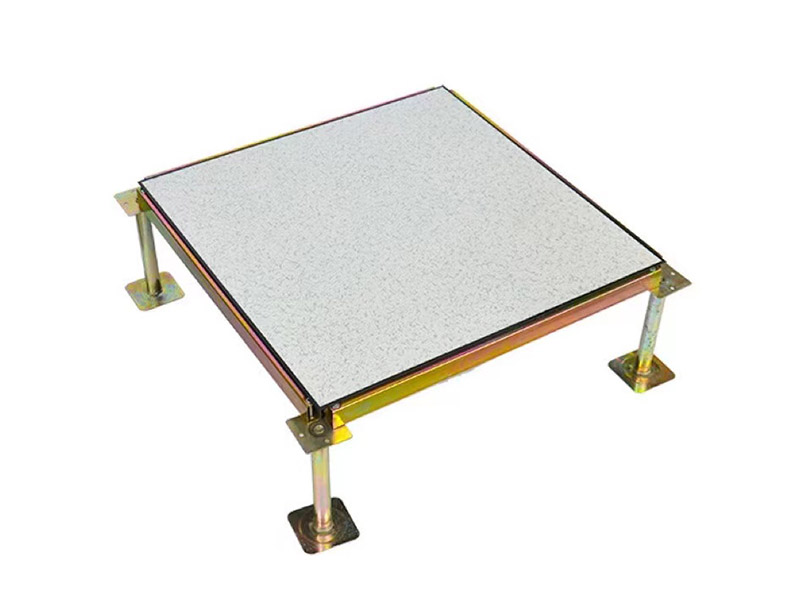
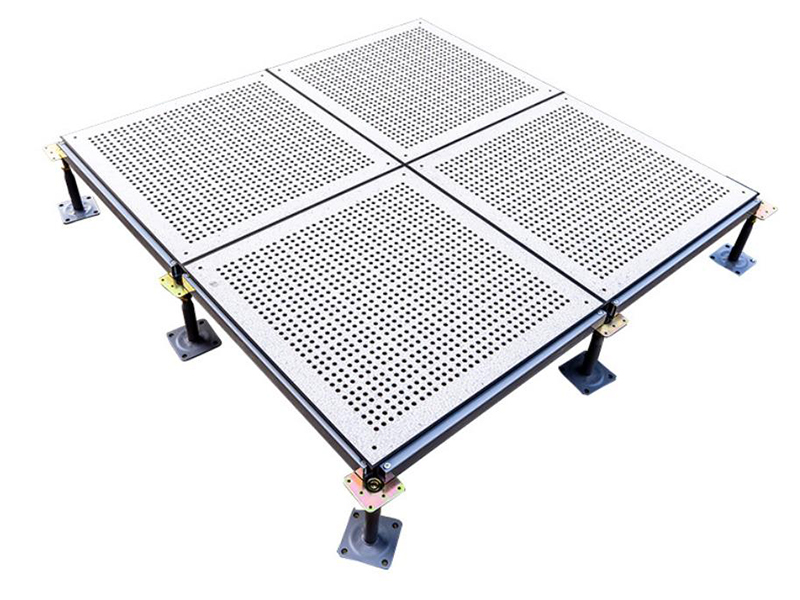
1. Steel Perforated Raised Floor
All-steel perforated panels are compatible with bolted stringer raised floor systems and offer between 15% and 75% free airflow rate, according to the manufacturer's specification. A top-surface adjustable damper is available, so airflow can be tuned panel by panel as rack density changes. Perforated panels are manufactured to the same size and finish as solid panels — typically 600 × 600 × 35 mm — which allows them to be swapped into an existing layout without a new substructure. High-pressure laminate, vinyl and rubber access floor coverings are available, and vinyl-faced perforated panels are interchangeable with woodcore and calcium sulphate perforated panels or tiles. Because the underfloor plenum doubles as a supply air passage, this type is often selected where cooling of high heat loads is the dominant requirement.
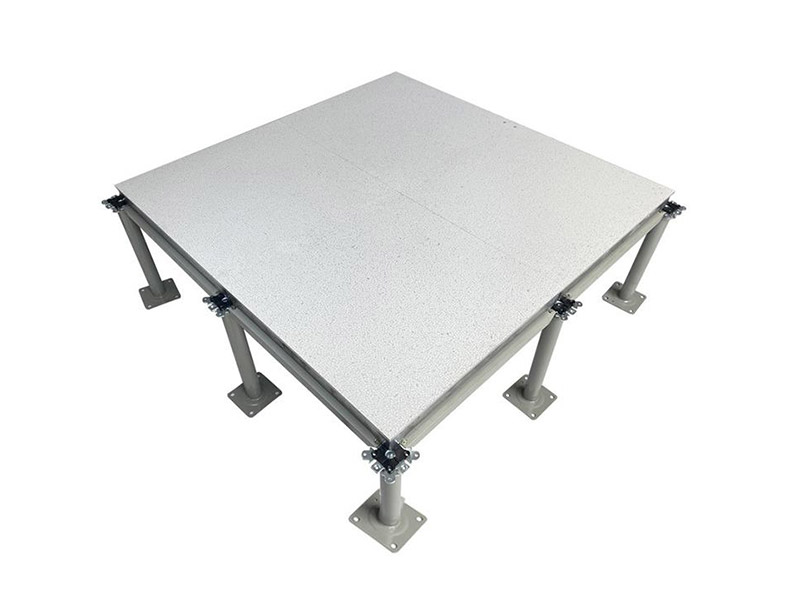
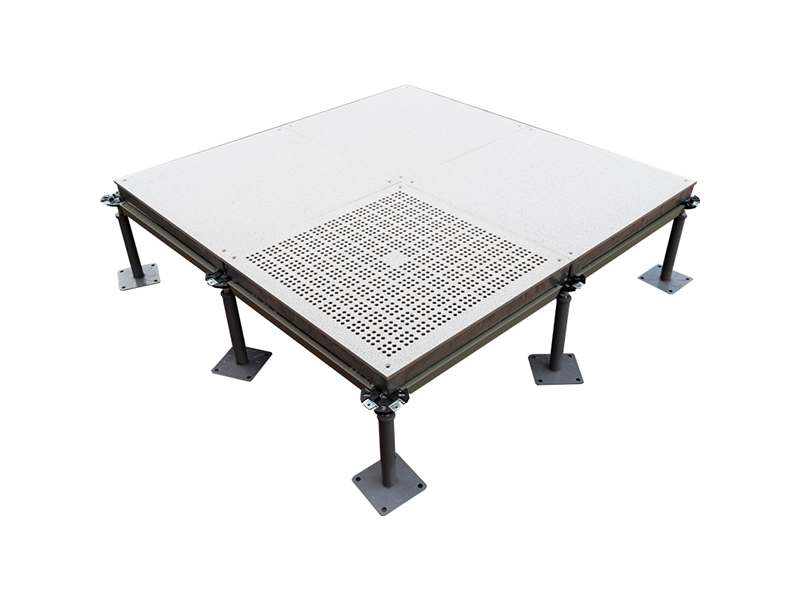
2. Aluminum Perforated Panel
Aluminium raised flooring is cast as a single aluminium alloy component under negative pressure, combining corrosion resistance with high strength. Its published characteristics include high dimensional accuracy, good electrical conductivity, fire resistance, anti-magnetic behaviour and resistance to deformation; die-cast panels are listed with an A1 fire rating and contain no ferrous material to disturb magnetic fields. The specified ventilation range is 15%–65%, with conductive and static-dissipative coverings available. Performance is stable in service, but the trade-offs are practical ones: maintenance cost is higher, maintenance work is more labour-intensive, lifting panels repeatedly can disturb the stability of the pedestal and stringer support system, and the work is normally assigned to trained personnel. These panels are common in cleanrooms, semiconductor and flat-panel display facilities where magnetic neutrality and precision are specified.
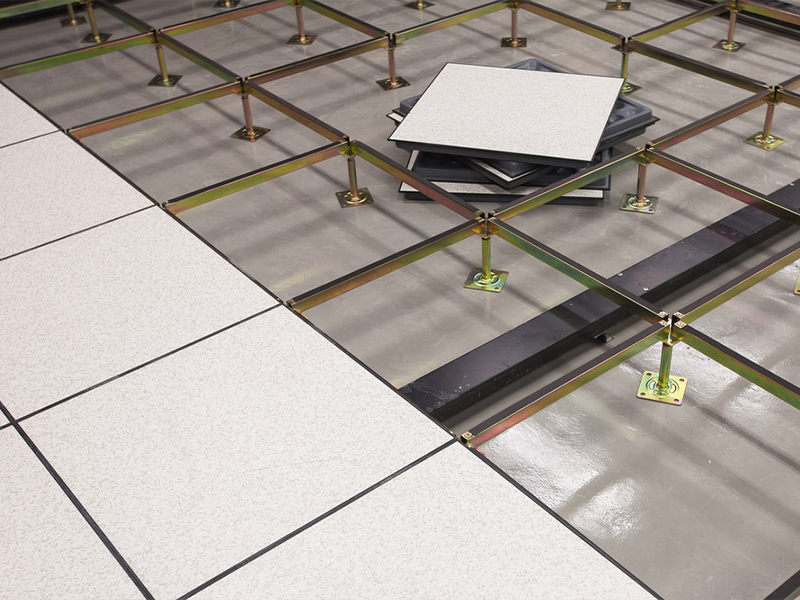
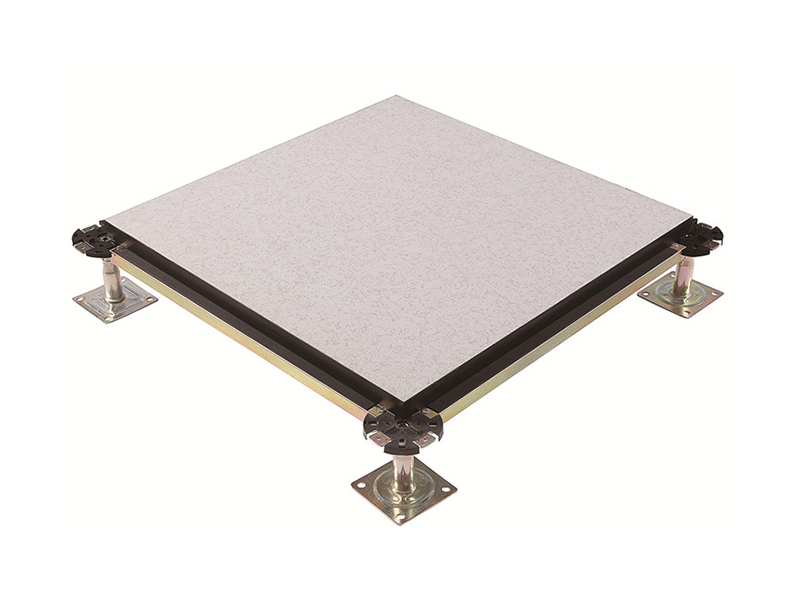
3. Anti-Static Calcium Sulphate Floor
An anti-static calcium sulphate raised access floor is built around a high-strength, fibre-reinforced calcium sulphate core with a steel sheet bonded to the bottom. HPL, PVC or anti-static ceramic tiles are bonded to the top, and a PVC edging strip is glued to each edge of the panel to reduce bubbling and unglued edges over time. Published data lists a core density of 1500–1700 kg/m³, core thickness of 22–38 mm, panel sizes of 500 × 500 mm and 600 × 600 mm, finished floor heights from 100 to 2000 mm, and a static dissipation range of 1.0 × 10⁶ – 1.0 × 10⁹ Ω. The dense core gives a firm underfoot feel and is listed as inherently non-combustible. This construction is often used in telecommunication rooms, power stations, computer rooms and factory clean rooms where a solid, non-perforated surface is preferred.
Installation Guidelines for Anti-Static Flooring in a Server Room
Grounding and Bonding
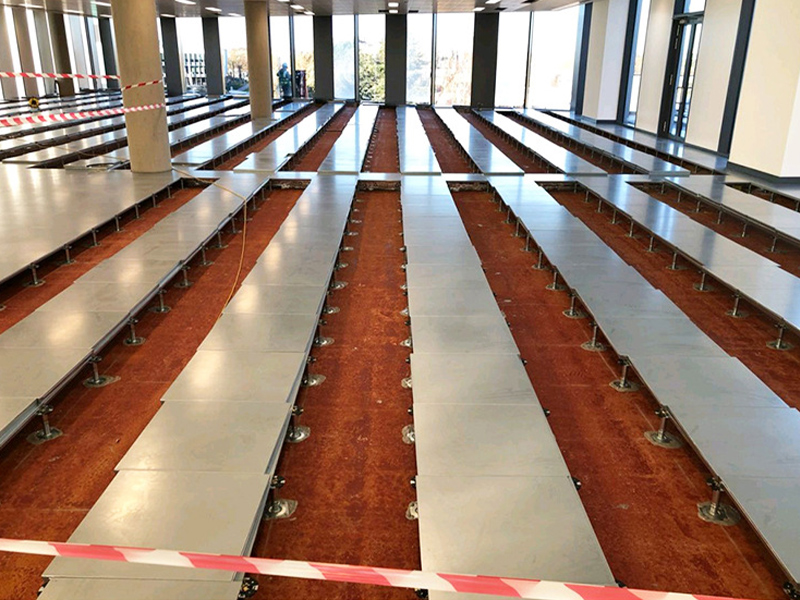
A dissipative surface only works when the path to ground is continuous. The installation team should verify that pedestals, stringers, panels and any conductive edge trim are electrically bonded, and that the whole assembly connects to the building grounding system at the points agreed in the design. Resistance measurements taken after installation, and again after any layout change, provide a baseline for later audits. Reading should be recorded under the humidity and temperature conditions stated in the chosen test method, since surface resistance varies with the environment.
Substructure, Level and Panel Fit
The structural slab is checked for level and cleanliness before pedestals are set. Pedestal height is adjusted to the specified finished floor height, and a stringer system is used where the panel type or load rating requires it; calcium sulphate systems are offered with or without stringers, so the choice follows the project's load schedule rather than habit. Perforated and solid panels of the same nominal size should seat interchangeably, with no rocking or edge steps that could catch a cart wheel.
Airflow Layout and Load Trade-offs
Perforated panels are positioned against the cooling plan rather than distributed evenly across the room. Concentrating open area at high-density rack intakes and sealing unused plenum openings helps keep supply air where it is needed. A higher perforation rate reduces the panel's load margin, so the airflow target and the concentrated, rolling and ultimate load ratings should be reviewed together. Optional dampers allow the volume through each panel to be adjusted without replacing the panel.
Access, Cleaning and Long-Term Care
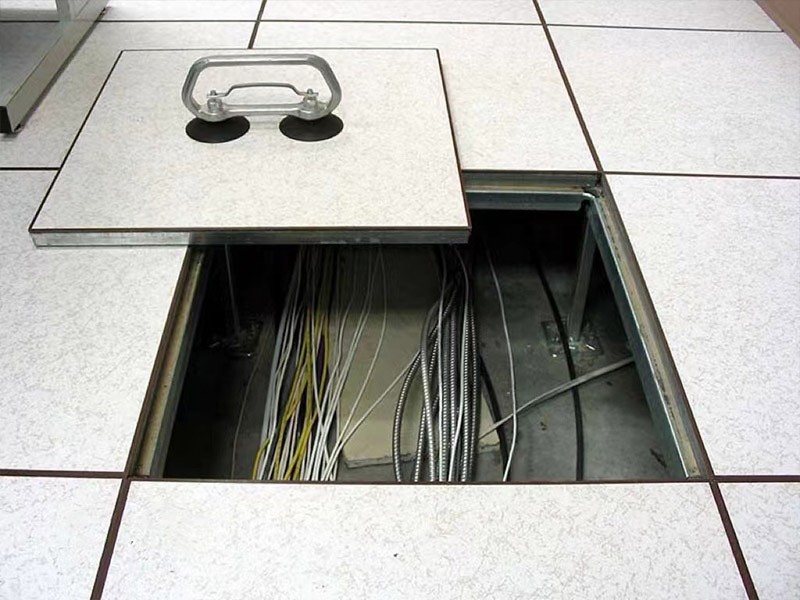
Panels are lifted with a suction-cup lifter so that the covering and edges are not prised up with a blade. Each lift is an opportunity to inspect the pedestal heads, stringer screws and the condition of the cabling below; repeated rough handling is a common cause of a loose substructure, particularly with aluminium systems. Cleaning uses neutral, non-abrasive agents that leave no insulating film, and maintenance records should note any panel replacement so that the electrical continuity of the floor can be re-checked. A practical installation reference and the room's ESD control documentation are usually kept together for this purpose.
Comparing Anti Static Flooring for Server Room Applications
| Item | Steel perforated panel | Aluminium perforated panel | Anti-static calcium sulphate panel |
|---|---|---|---|
| Core / base | All-steel hollow panel with a steel bottom sheet | Single die-cast aluminium alloy component | Fibre-reinforced calcium sulphate core with bonded steel bottom sheet |
| Published airflow range | 15%–75% free area | 15%–65% ventilation rate | Solid panel; perforated versions are supplied separately |
| Typical panel size | 600 × 600 × 35 mm | 600 × 600 mm | 500 × 500 mm / 600 × 600 mm, 22–38 mm core |
| Surface options | Bare powder coat, 1.0–2.0 mm anti-static HPL, 2.0–3.0 mm PVC, 10 mm ceramic | Conductive and static-dissipative coverings; bare powder coat, HPL, PVC, ceramic | Anti-static HPL, PVC, ceramic, marble, granite, natural wood; PVC edge strip |
| Static performance | Dissipative coating on the finished panel | Conductive alloy body with dissipative covering | Listed dissipation range 1.0 × 10⁶ – 1.0 × 10⁹ Ω |
| Installation and upkeep notes | Stringer system; optional damper; interchangeable with solid panels | Stringer system; higher maintenance cost and labour; trained personnel recommended | With or without stringers; edge strip reduces bubbling and unglued edges |
| Common application | Data halls and server rooms with underfloor air distribution | Cleanrooms, semiconductor and display production areas | Telecom rooms, power stations, computer rooms, factory clean rooms |
Figures above are nominal values published on the linked product specification pages; project requirements should be confirmed against the final load schedule, cooling plan and test certificates before ordering.
Conclusion
Anti static flooring for server room projects is an investment in protection and service life rather than a visible item of equipment. A static-dissipative floor controls charge where it is generated, reduces the risk of electrostatic damage to processors, memory and storage, supports a safer working environment, keeps dust manageable and contributes evidence to a documented ESD control programme. Selecting between perforated steel, perforated aluminium and calcium sulphate constructions means balancing airflow, load rating, magnetic and fire requirements, and the maintenance capability of the facility. Correct grounding, a level substructure and disciplined access procedures determine whether those characteristics persist after installation. Protecting expensive hardware may not translate directly into revenue, but it is a substantial part of keeping an electronics-dependent operation running.
If you are looking for a dependable anti-static raised access floor manufacturer, ZiLi Floor is worth considering.
FAQ
What does anti static flooring for server room applications actually do?
It provides a controlled, dissipative path from the walking surface through the panel and substructure to the building ground, so charge decays gradually instead of discharging through equipment.
Is an anti-static floor sufficient on its own to protect servers?
No. It is one element of an ESD control programme that also covers grounding verification, footwear, wrist straps, humidity, packaging and handling procedures.
How do perforated steel and aluminium panels differ?
Steel panels are listed at 15%–75% free area and suit high heat loads; aluminium panels are listed at 15%–65%, are anti-magnetic and corrosion resistant, and involve higher maintenance effort.
Can perforated panels replace solid panels in an existing raised floor?
Panels of the same nominal size and finish are generally interchangeable, but the load rating of the perforated version should be checked against the rack and rolling loads first.
How often should floor resistance be checked?
After installation, after any panel or layout change, and at the intervals defined in the facility's ESD control documentation, using the same test method and environmental conditions each time.
Does a calcium sulphate panel require a stringer system?
It is offered both with and without stringers. The decision follows the specified concentrated and rolling loads rather than the panel type alone.
Have a load rating, panel size or resistance range to review? ZiLi Floor can help evaluate the specification.
Contact Us